

Developers
MW Zapata, MC Snaer, DK Valerio, & NC Habana
Coming Soon!
WERI Technical Report
View
MAppFx
About
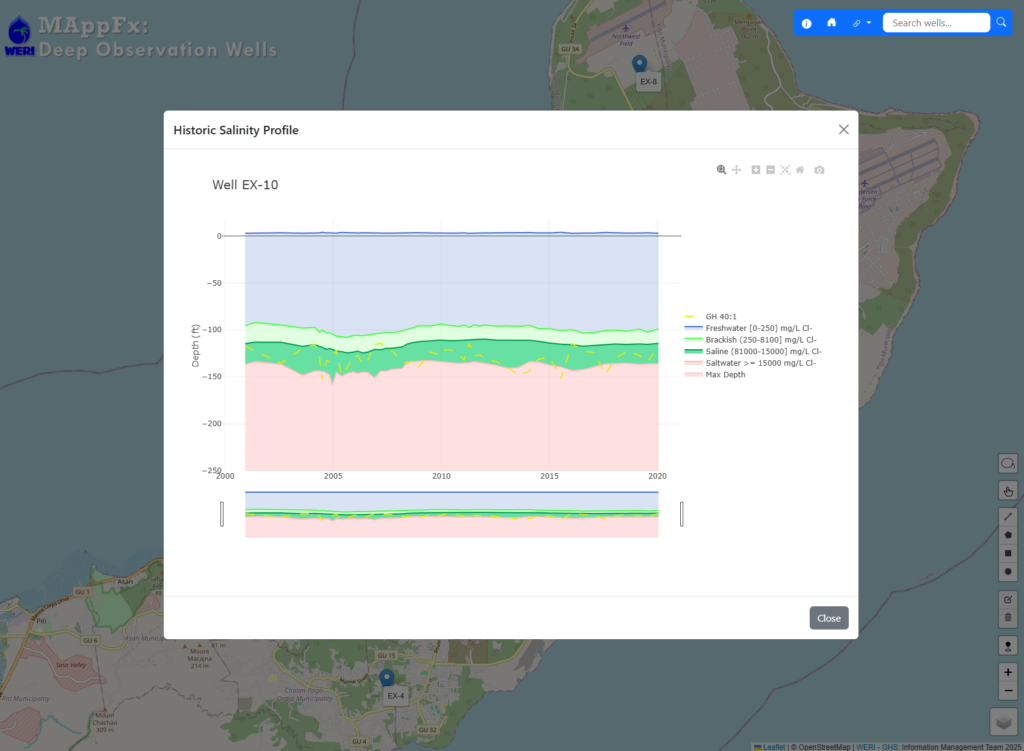
Deep observation wells (DOWs) are phreatic access ports for conducting salinity profiles in the NGLA. A DOW is a vertically positioned tubular structure that extends down a borehole with perforation below the saturated zone, penetrating the freshwater lens, extending into the saltwater zone. This allows for a depth and conductivity analysis that translates into a salinity profile. The salinity profile sampling is done at least twice a year. This operation was conducted as part of the WERI-USGS data collection under the CWMP. Dougher et al. (2019, WTR 168) developed the first historic graphing of salinity profiles for three DOWs in the Tomhom Aquifer, NGLA. The report defines the phreatic zone of freshwater, transition zone, and saltwater. Dougher’s research revealed the capacity and durability of the aquifer that went through a major recharge event from typhoons, followed by a 6-year drought. In 2024, the WERI GHS IM team started developing the historic graph of phreatic zone for the DOWs as a component of the MAppFx web app. On the MAppFx interface, users see 8 DOW historic profiles that began in 2001. In the future, it will include the newly installed DOWs of both GWA and Military. The WERI GHS IM team was able to create a workflow that converts the raw Excel data to MAppFx’s input and database file, JSON. This system is easy to manage and update when new data is received. DOW salinity profiles alone are difficult to analyze and present in such a way that could be well understood. Historic salinity profiles provide a better and valuable insight for determining the status of the aquifer, showing changes in freshwater lens thickness in response to drought and ample recharge. MAppFx makes this easier to visualize and support with the management of the island’s major water resource.